
天眼
Can humanoid robots move beyond the games?_我的网站

A | Shah Rukh Khan is preparing in full swing for his upcoming film, King and is also training his daughter Suhana Khan, who will make her theatrical debut with the Siddharth Anand directorial. During an event in Dubai, that was attended by SRK and filmmaker Farah Khan, the latter revealed that the actor is training Suhana on set, especially for action scenes. During the launch of a commercial tower named after the superstar, Farah said, "Shah Rukh’s son Aryan has made the most kick-a** web series, The Ba***ds of Bollywood. Suhana is so hardworking. She is now going to be in King. I know that you are training her in action." View this post on Instagram A post shared by Siddharth Anand (@s1danand) Suhana Khan made her Bollywood debut with Zoya Akhtar's The Archies, which streamed on OTT. Now, the star kid is all set to make her theatrical debut. King has created a buzz among fans due to its impressive ensemble cast and grand scale. The official title announcement took place this year on SRK's birthday. The clip opened with a high-octane, stylised action sequence that sees SRK's character take down enemies. It is followed by a deep and chilling voiceover, "Kitne khoon kiye, yaad nahi...Acche log the ya bure, kabhi pucha nahi. Baas unki aankhon mein ehsaas dekha, yeh unki akhri saans hai. And main uski wajah." (How many people I’ve killed, I don’t remember. Whether they were good or bad, I never thought about it. I just saw it in their eyes… that this was their last breath. And I was the reason.) Backed by Red Chillies Entertainment and Marflix Pictures, King features a stellar cast of big stars, including Abhishek Bachchan, Suhana Khan, Deepika Padukone, Rani Mukerji, Raghav Juyal, Jaideep Ahlawat, Arshad Warsi, Saurabh Shukla, Abhay Verma, and others. The movie is currently in production and is scheduled for a grand release in 2026. Also Read: Here’s Why Shah Rukh Khan Doesn’t Want Suhana Khan to Have Black Coffee。
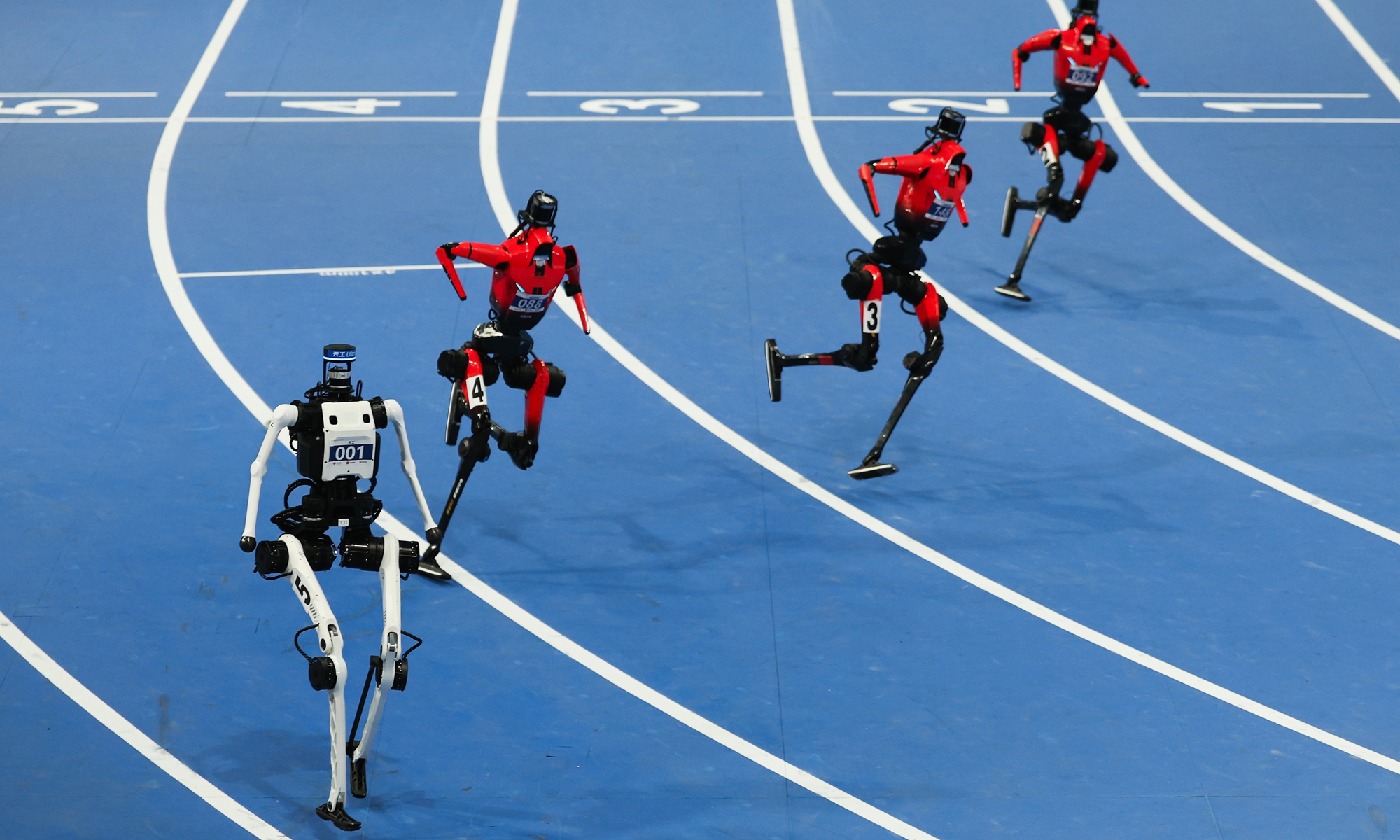
On the blue track inside the National Speed Skating Oval, robots chased each other in the 400-meter race. A sprinting Tien Kung robot was tripped by a rival robot lying on the track but did not fall. Instead, it adjusted its posture in seconds and continued toward the finish line with a result of 38.15 seconds, breaking human 400-meter race world record of 43.03 seconds, held by South African athlete Wayde van Niekerk.
This scene unfolded on Sunday, the first official competition day of the 2nd World Humanoid Robot Games (WHRG). Later that evening, a humanoid robot named Lightning, developed by Honor Co., broke the long-standing human 1,500-meter world record of 3:26 set by Moroccan athlete Hicham El Guerrouj with a time of 2:30.22. Just one night earlier, during the opening ceremony's 100-meter sprint and high jump demonstrations, humanoid robots had already shattered records long held by human athletes Usain Bolt and Javier Sotomayor — merely an appetizer for the five-day sci-fi spectacle.
The Games have attracted 666 teams from 16 countries across six continents, up 138 percent from its inaugural edition. The number of participating robots quadrupled to 2,056, the Global Times learned from the organizing committee.
Yet the biggest change this year was not only the scale, but also the technological maturity. More teams have shifted from remote-controlled robots to fully autonomous systems. Chinese observers, after watching several events, said humanoid robots are no longer limited to simple demonstrations of walking or dancing. Increasingly, they are being tested in environments that demand speed, coordination, perception and decision-making.
From movement to intelligence
Behind the record-breaking performances are a series of technological upgrades. During the running events, Global Times reporters observed that robots were able to make subtle movements around their hip joints while walking, allowing them to maintain balance and produce movements closer to human biomechanics.
Guo Yijie, technical director of Tien Kung Ultra, said the improvement came from advances in hardware design.
"Robot joints have improved in torque and speed. As competitions demand higher power output, the reliability of the main control board, power board and high-power battery discharge capability have become increasingly important," Guo told the Global Times.
According to Guo, the same Tien Kung Ultra robot was used in both sprinting and jumping events. For running, the waist needs rotation to balance the inertia generated by leg movements. For jumping, the upper body requires pitching movement to help the robot achieve greater distance or height, Guo said, noting that these can all be achieved with only slight adjustments to the waist configuration were needed, and it highly demonstrated to the robot design's flexibility.
Besides the hardware upgrades, developments in robots' faster decision-making in "brains' is better showcased in football competitions.
The Booster T2 robot used by many domestic and overseas football teams has increased its onboard computing capability by 10 times compared with the previous generation. The time from recognizing the goal to deciding whether to pass or shoot has been reduced to around 100 milliseconds - faster than the time humans usually need to blink.
Cheng Hao, a technical representative from Boosters Robotics, said the improvement represents an "end-to-end" transformation in embodied intelligence.
"In the past, robots relied on separate steps: perception, planning, decision-making and execution. Each stage was disconnected. Now, with an end-to-end motion foundation model, visual input can directly generate joint control commands," Cheng said.
The newly introduced table tennis and tennis competitions are also testing another important capability: perception.
"Robots are moving from simply recognizing the three-dimensional position of a ball to understanding the movement information of opponents and more complex environments," said Li Yinghui, a postdoc researcher and the leader from the Hong Kong University team at the table tennis event. Such capabilities developed in sports scenarios could eventually be transferred to other scenarios in industries or daily life, Li said.
Beyond entertainment
Though clips from the robot competitions have made a buzz on social media, with some critics from Western media questioning why robots need to dance, play football or compete in athletics while arguing that these activities appear far from everyday needs.
Zhou Changjiu, Vice President of the RoboCup Federation and the Robotics Competition Association of the Asia-Pacific (RCAP), stressed robot sports are not designed for entertainment alone. "Robot competitions are testing the capabilities needed for humanoid robots to enter the real world," Zhou told the Global Times.
Different events evaluate different abilities. Sprinting tests speed, marathons examine battery endurance and energy management, while football provides a comprehensive test because of its dynamic and unpredictable nature, testing intelligence, manipulation, interaction, safety, cost and trust at the same time, Zhou said.
Unlike a single-task demonstration, football requires robots to cooperate. Players must understand their own roles, recognize teammates and opponents, and make collective decisions - a form of swarm intelligence that could become essential when robots work together in homes, factories and emergency rescue environments.
Entertainment, however, can generate business opportunities. Gu Jinghai, brand director of EYOU Robot Co, told the Global Times that the company sold 95,000 integrated joints in China in 2025 and expects sales to exceed 1 million units in 2026. Growth mainly comes from planetary joints used in entertainment robots, while harmonic joints for industrial robots are also expanding steadily, he said.
Jiao Jichao, an executive from UBTECH Robotics, said the criticism that "Chinese robots can only sing and dance" reflects only a temporary stage of development. "Performance and dancing are also real commercial demands, and their existence has value," Jiao said. "Beyond entertainment, Chinese robots are already demonstrating intelligent capabilities that support practical applications in manufacturing, and partnerships with companies including Huawei and Foxconn, where robots have already entered production lines in small-scale applications."
The Outline of the 15th Five-Year Plan for National Economic and Social Development of China stated that the country will construct a comprehensive cultivation system for future industries including the embody intelligence as new economic growth drivers.
Zhou said the development of humanoid robots is not only about individual machines, but about building an entire ecosystem.
China's advantage lies in its complete supply chain, abundant application scenarios and manufacturing capabilities, while the fast growing industry still faces challenges such as the lack of unified standards.
Gu said the company has launched mass production of robotics joint under domestic standard of auto parts.
Robot competitions can help address these issues by creating common standards in areas such as competition rules, robot dimensions, communication systems, batteries and joint modules. "As applications expand, the cost of key robot components will continue to decline," Zhou said.
"Numbers are magic," Zhou said. "If producing one robot costs a huge amount because it is handmade, producing one million robots will completely change the cost structure."
For humanoid robots, the race taking place inside the Ice Ribbon may not ultimately be about who crosses the finish line first. It may be about whether these machines can learn to navigate the far more complicated race outside the stadium - the race into the real world.
。

B |
Current article:http://8gneali.bomanglangsugangunxileba.cyou/list_jaa2/g0xnqa4.html
Published on:12:19:25
我的网站相关阅读
- PLA Navy Task Force 83 returns after completing far-sea training and visits to Russia, Vietnam, Brunei and Indonesia
- 江苏常州通报:星宇股份已对人力资源总监作停职处理,不存在违规享受就业和人才类政府补贴行为
- 道路改造换新颜 铺就民生“幸福路”
- LinkedIn机器人大战抹掉了一半的苹果员工账号
- “十五五”将优化新能源车配套让消费者愿意买放心用
- 网站SEO优化入门:TDK设置、内链结构、sitemap配置
- 深夜台湾突发地震,浙江多地有震感,网友:家里的吊灯摇得很明显
- Depp Set to Return to Pirates of the Caribbean After Defamation Trial Win Against Heard - Report
- 唐家三少当选北京作协副主席,日前宣布停更
我的网站最新文章
- 21家公募中报放榜:南方基金15亿净利暂领跑 永赢反超银华、大成
- 好热!奥克兰迎来史上第五高温日,全国气温本周将骤降
- 疑电池爆炸烧屋邻居施援手 青年竟拒逃生
- 2024东北亚(兴城)国际泳装展 13大专业展区同启 830家展商参展
- 玛格丽特·库里赤足走红毯 穿香奈儿“无底鞋”
- Small plane crashes into multifamily house in US, kills everyone on board
- 【乐学儿童】机幼宝贝上春晚啦!
- 老铺黄金:上半年收入198.1亿元,同比增长60.3%
- 新兴技术及应用产业日报(07.20) : AI赋能产业
- 饮食健康知易行难,平安管家陪伴客户养成好习惯,饮食健康知易行难,平安管家陪伴客户养成好习惯
- 机构:存储短缺导致平板显示器市场下滑
- WNBA常规赛前瞻:凤凰城水银VS华盛顿神秘人
- 一次性补贴3000元!今起开始申请,符合条件的别错过
我的网站随机推荐
- 绥中荒地镇开展“守护蔚蓝海岸,环保从我做起”活动
- 「あ、コケた映像が出たw」五輪閉会式、再三脚光を浴びた日本人ペアにファン感激「めっちゃ映るなw」「マジで好かれたな」【冬季五輪】
- 山东临清一女孩在玉米地被多人殴打,警方:涉案人员已全部到案
- 捷豹路虎砍开支保揽胜 卫士换代被按暂停键
- 停车场石墙倒塌 骑士吓坏纷移车
- 让二追三!十人胜利3-2逆转达曼协作,马内双响,C罗半场被换下
- 2025香港车博会:奇瑞风云A9L等多款车型亮相
- 全市招商引资工作组调度推进会议召开
- 宅家拼豆撬动消费新热潮
- ‘Why Isn’t MAGA Inc. Funding Everyone’s Defense?’
- 打响金“蒜”盘 走上致富路
- 小鹏第二代 VLA 首次模型重大升级:响应速度提升 3 倍,G9L 车型全球首发
- 消息人士称美中情局局长正在俄罗斯进行会谈